
- Conference Report 2025
- Conference Report 2024
- Conference Report 2023
- Conference Report 2022
- Conference Report 2021
- Conference Report 2020
- Conference Report 2019
- Conference Report 2018
- Conference Report 2017
- Conference Report 2016
- Conference Report 2015
- Conference Report 2014
- Conference Report 2013
- Conference Report 2012
- Conference Report 2011
- Conference Report 2010
- Conference Report 2009
- Conference Report 2008
- Conference Report 2007
- Conference Report 2006
- Conference Report 2005
- Conference Report 2004
Conference Report 2018
Writers, familiar and new, as well as supporting friends, were welcomed at the Royal National Hotel, London for our 2018 annual conference.
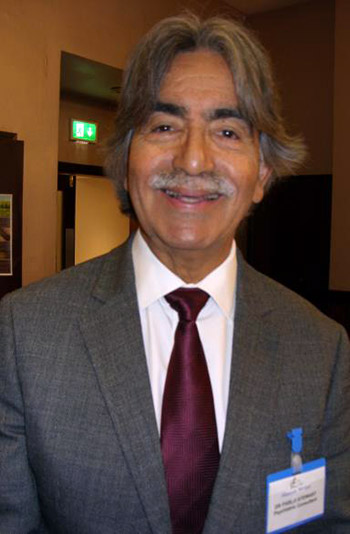
Caroline Dipple introduced our first speaker, our old friend, forensic psychiatrist Dr Pablo Stewart, who works ceaselessly on appeals for those on Death Row. Pablo began by emphasising the importance of letter writing. He updated us on one of his clients, Robert Holland, who he had spoken about at last year's conference. Robert had received many letters of support and encouragement from HW members following Pablo's address last year and it was heart-warming to now learn that he is doing much better and no longer volunteering for execution. Pablo then summed up the political situation in the US, clarifying that although the Supreme Court is now likely to be supportive of Trump’s measures, there is a silver lining to the chaos of the government in as much as there have as yet been no organised efforts to reinforce the death penalty and no recent executions at federal level. Pablo reiterated however that some states are "champing at the bit" to execute. He spoke briefly about the situation in Tennessee where one execution had already taken place this year, together with the passing of a law now making it illegal to publish information regarding the supply of lethal drugs, thus ensuring its secrecy. California was also highlighted, with now over 740 prisoners on the Row, twenty of whom have exhausted all appeals. Pablo also mentioned the August execution of Carey Dean Moore, the first that had taken place in Nebraska for over twenty years. He then spoke briefly about David Miller in Tennessee who is scheduled to die on 6th December. Pablo sees little likelihood of reprieve, but believes our letters will help David to know he is in our thoughts.
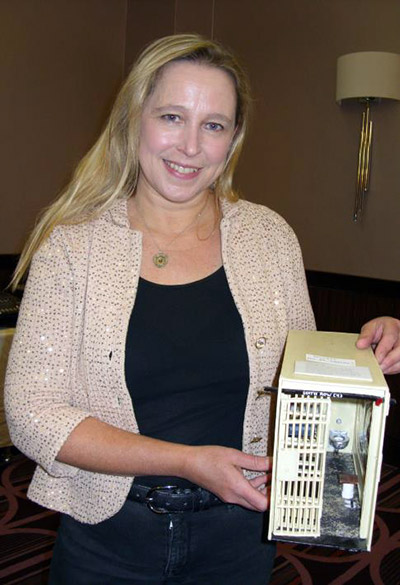
Our second speaker was Nicola White of ArtReach, an organisation that connects writers and artists from Death Row in California with the outside world. Nicola gave an extremely effective presentation in which we had the privilege of not only seeing artwork and photos of the team of contributors but also bringing them into the heart of the conference with us via recordings made over the prison telephone. Poet and writer Steve Champion was the main spokesperson for the team. He explained how his writing connects him with the outside world and represents the highest form of hope. He described artistic creativity as "a triumph over despair and sadness” allowing the artist to transcend borders (and bars) and fight off the sense of invisibility felt by many enduring incarceration, leading to self-transformation and essentially spiritual enlightenment. Steve emphasised man’s primal need for self-expression, something which many prisoners have not had the opportunity to do. He then recited his own poem A Bus Ride Moment detailing a brief encounter on a bus as he was transported back to county jail after a day in the Federal courts in 2006. We then met Bill Clark, who has overcome the trials of twenty years on the Row by exploiting his freedom to create, feeling that his “mind, heart and spirit” are free. Bill draws political cartoons, writes poetry and plays and loves to share his work which fills him with “hope, joy, a sense of achievement" and creates a “positive legacy”. His talk concluded with a reading of his powerful poem A Cell With No Bars. We saw the fine pictures in ink stippling by Keith Loker, the strong images of Daniel Landry who uses art to transform his thoughts of suicide, the distinctive African paintings of Alphonso Howard, who also read his poem Smiles, and we heard some of the poetry of Ojore McKinnon accompanied by his pictures of wildlife. Wildlife was also the subject matter, but in a very different style and medium, of Royal Clark, while Albert Jones has a unique way of painting on fabric and Louis Maciel produces complex pencil drawings based on his thoughts and dreams. Examples of the work of all these artists and more can be found at www.artofsanquentin.com.
Nicola concluded her presentation by showing us a small model of a Death Row cell made entirely out of cardboard by Christopher Spencer. Human Writes has been privileged to include the work of many of the San Quentin artists and writers in our newsletters over the years.
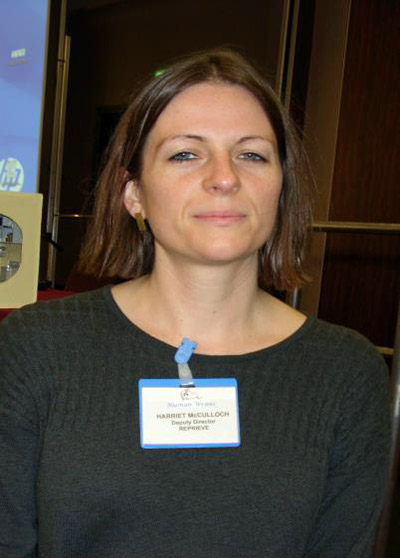
The third speaker of the morning was Harriet McCulloch, Deputy Director of Reprieve. Harriet explained the aims of the organisation which assists people around the world facing execution, and those victimised by states’ abusive counter-terror policies - rendition, torture, extrajudicial imprisonment and extrajudicial killing. Reprieve seeks to hold the US and their European allies accountable to the highest standards in their responses to extreme crime. Harriet then spoke about Malawi, where the mandatory death penalty (which meant the sentencing judge had to impose the death penalty for certain offences) was abolished in 2007. Since 2014, Reprieve has worked with Malawian and international partners to ensure those prisoners originally sentenced to the mandatory death penalty are given new discretionary sentencing hearings. These hearings have seen over 130 prisoners released from prison, with the vast majority returning back into their local communities where they are given the chance to flourish and give back to the community, on the understanding that individuals can and do change. None of over 160 prisoners in this project were re- sentenced to death, although the death penalty is still an available sentence in Malawi.
After the state group meetings and lunch break we convened to listen to our afternoon speaker, Sabrina Butler-Smith. Sabrina's story featured in the Summer edition of our newsletter. Speaking as a representative of the Witness to Innocence Network, Sabrina told her story, explaining in detail the sadness and horror of the death of her baby, the subsequent trial and the terror of receiving a death sentence. She had been only eighteen when this happened to her and had been poorly represented at court and during her initial incarceration.
No-one had explained to her that her death date was provisional and dependent on appeals. Finally her plight came to the attention of Mississippi lawyer Robert McDuff and Clive Stafford Smith of Reprieve. Together they were able to investigate and reveal the truth of the circumstances of the death of Sabrina's baby, considered to be due to internal disease, likely attributable to environmental issues near her home. A retrial was held at which Sabrina was exonerated of all charges and, at the age of twenty-five, she was freed to start her life again. Sabrina spoke of challenges she is still facing such as obtaining amendment to her baby's death certificate and to be allowed access to her son's remains. She then gave a brief insight into her life on Death Row and how she had survived this, mainly through writing a daily journal, reading widely and learning how to manage her anger. She puts her personal positivity down to self-help tapes which have trained her to become mindful and emotionally stable.
Sabrina believes that the death penalty is racially motivated against the young, poor and black and she has dedicated her life to try and bring about a change in the American justice system. Sabrina ended on a positive note and our good wishes will be with her in the years to come.

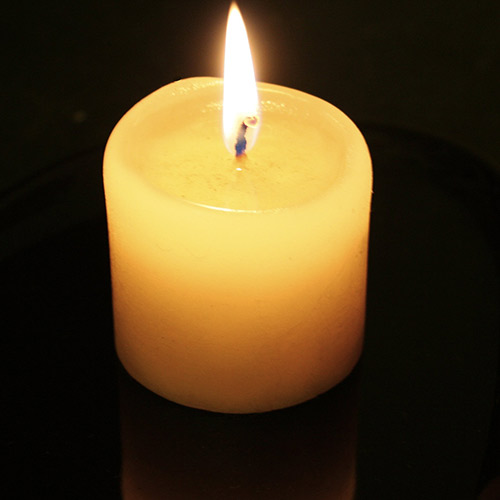
We began the final session of the day with the traditional lighting of two candles - one for all those executed by the US and one to also remember and acknowledge victims of crimes. A minute of silence followed for reflection and personal thought. The day ended with some words from Sue Fenwick, our founder, who warmly thanked all our speakers for their contributions to what had been a superb conference. Thanks were also expressed to Sonya Woodsend, our conference organiser, for all her work and planning towards a very memorable day. Sue spoke briefly about the organisation's activities and updates in the past year and ended by thanking our members for their continued support and encouragement, both to Human Writes and to their penfriends.
In a Death Row prisoner‘s own words:
“It‘s about my penpal she has changed my life from a mental hell, her letters have rolled back the clouds in my life and allowed the sunshine to burst thru. I am so impressed by this beautiful women that I am not ashamed or embarrassed to acknowledge her as my friend – Best Friend. I couldn’t love her more.”
“It‘s about my penpal she has changed my life from a mental hell, her letters have rolled back the clouds in my life and allowed the sunshine to burst thru. I am so impressed by this beautiful women that I am not ashamed or embarrassed to acknowledge her as my friend – Best Friend. I couldn’t love her more.”
Human Writes Patrons
"The very essence of the death penalty is to tell people that they are somehow sub-human, not fit to live. Yet even those people I have represented who did what they were accused of - a surprisingly limited number - have always been much better people than their worst fifteen minutes, as are we all. Those who recognise this by reaching out to the men and women on death row are true heroes, though I suspect they gain as much as they give to the relationship."
Clive Stafford Smith OBE, Founder of Reprieve and Patron, Human Writes
"As a journalist who has lived and worked in the United States, the horror of death row is one of the issues that never leaves you. The thread of humanity that Human Writes manages to sustain with men and women on death row is a profound contribution to keep alive the hope of life. Capital punishment is now on the retreat in America, but the numbers awaiting their fate are still very considerable. I am very honoured to have become a Patron of Human Writes and will hope to do my best to put my shoulder to the wheel".
Jon Snow Broadcaster and journalist, Patron, Human Writes
"I know what it is like to live in a cell for decades and feel that the whole world hates you. I never expected to be able to live again as a contributing member of a community. Prison life was precarious and unpredictable but I met people who worked there who wanted to help me and people like me - and I'm lucky that I live in a society graceful enough to offer me a second chance. At least I had hope. Hope for many of the people supported by Human Writes has all but been extinguished. Letters to people on Death Row let them know that however low they may have fallen, they are still human beings. They still have value and are worth caring about and letters might just help to keep hope alive. That is why I am honoured to have been invited to be a patron."
Erwin James 1957 - 2024, author and Guardian columnist, Patron, Human Writes
Past Reports
Prisoner Art and Writing

"The volunteers of Human Writes seek to hold out the hand of friendship to men and women facing the death penalty. I am pleased to encourage them in their writing"
Most Reverend and Rt Hon George L Carey, former Archbishop of Canterbury
"No matter its circumstances, dying is one of the most important things we ever do. I applaud all who offer compassion and hope to those facing death, especially in the terrible circumstances of Death Row. May God bless your work."
His Eminence Cardinal Vincent Nichols, Archbishop of Westminster